


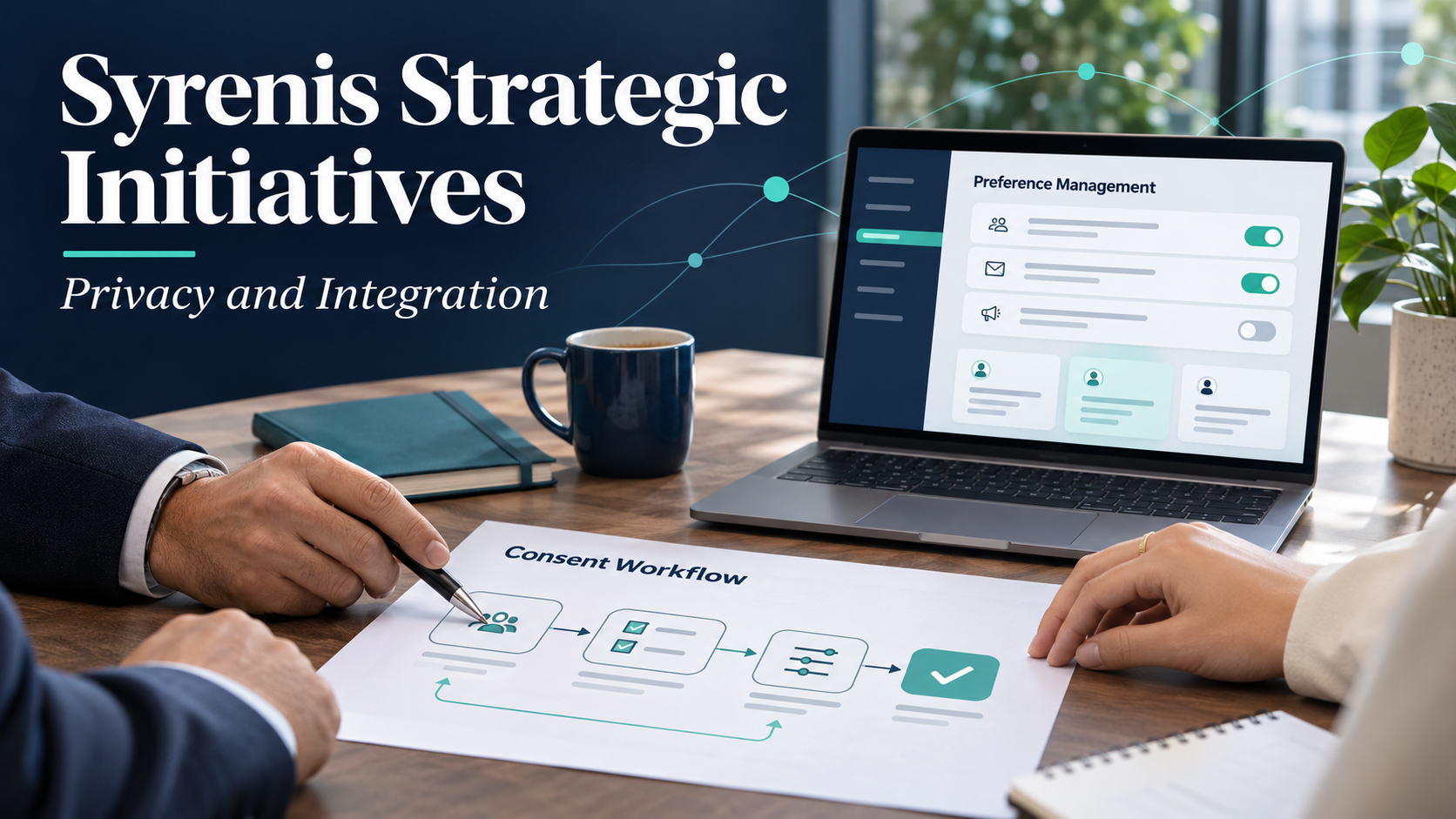
Syrenis Strategic Initiatives is best understood as a search for the privacy-software company’s direction, rather than the name of a separate product or a publicly verified internal programme. Its current website emphasises connected consent records, customer preferences, privacy governance and integration across enterprise systems.
Those priorities have a practical theme: a customer’s choice should remain usable after it leaves the screen where it was collected. A marketing team, service desk and software platform can otherwise hold conflicting versions of the same preference. The following analysis separates Syrenis’s published product positioning from an independent evaluation of what a buyer should verify.
What Syrenis Actually Provides
The official Syrenis website presents an enterprise consent and preference management platform, organised around consent management, preference management, risk and policy, and data management and integration. These are software capabilities offered to organisations, not a consumer subscription for managing an individual’s entire online identity.
The company’s materials also use the Cassie name. An official Cassie product overview describes it as powered by Syrenis. Readers encountering older documents should therefore compare product names, publication dates and current scope instead of assuming that every differently branded document describes a different supplier.
A company’s description establishes what it offers and how it positions itself. It does not, by itself, prove the performance of a particular deployment, the suitability of every integration or compliance with every rule in every country. Those questions require implementation evidence, contractual detail and review of the organisation’s actual processing.
Syrenis Strategic Initiatives: A Connected Consent Record
One clear priority in the published material is reducing fragmented consent information. The intended result is a consistent record that different applications can consult and update. That is more substantial than displaying a cookie banner: it concerns what happens when information moves through the organisation.
Consider an illustrative customer who withdraws promotional email permission through a service representative. If the change remains in a service-system note while a separate campaign platform keeps sending messages, the visible preference centre has not solved the operational problem. A useful evaluation should trace the change through every relevant destination.
This example is a proposed test scenario, not a report of a specific Syrenis customer’s failure or success. It helps translate the broad promise of connected consent into something a buyer can demonstrate: capture a choice, transmit it, check the receiving system and show the resulting decision.
Integration Is a Core Part of the Direction
Syrenis describes an API-first approach. Its Connector Service resource discusses a common interface for communicating with external applications and identifies RESTful and SOAP-based interfaces. This is relevant to organisations whose existing systems use different technologies and cannot all be replaced at once.
However, the existence of an API is only the start of an integration assessment. A project still needs to define identifiers, permission scopes, message formats, update rules and failure handling. Two applications may agree on an email address while disagreeing on whether a preference applies to a brand, channel, purpose or individual campaign.
Ask a supplier to demonstrate both a successful update and an interrupted one. What happens if the destination is unavailable? How are retries handled? Can the team identify records that have not synchronised? These questions concern implementation quality and should be answered for the proposed configuration rather than inferred from a general product page.
Preferences and Consent Are Related but Different
A person may prefer weekly messages rather than daily messages, while separately deciding whether the organisation may use a particular category of personal information. Treating every preference as legal consent, or every consent as a complete statement of communication preferences, can create misleading records.
Syrenis’s role-based platform overview presents use cases across privacy, legal, marketing, customer experience, engineering and data teams. The important implication for a buyer is shared responsibility. A technically valid message can still implement the wrong organisational rule if the teams have not agreed what each field means.
A useful project document should define each choice in plain language, identify its purpose and explain which systems must honour it. A preference labelled “updates,” for example, is too vague if different departments use it for product announcements, service notices and third-party advertising. The vocabulary needs to be clear before automation distributes it.
Privacy Governance Extends Beyond the Banner
The company’s Risk and Policy page describes capabilities around privacy notices, risk records and rights-request workflows. This broadens the platform’s published scope beyond collecting an initial choice. It also raises a different set of evaluation questions concerning responsibility, evidence and review.
For a rights-request workflow, examine who receives the request, how identity is checked, which systems are searched, how exceptions are escalated and what record remains after completion. A dashboard is useful only if the organisation understands the actions behind its status labels.
Similarly, version tracking can help preserve which notice a person saw, but it does not determine whether that notice was clear or legally sufficient. Governance tools organise evidence and workflow. Decisions about the applicable law, lawful basis and necessary disclosures still require competent review of the real circumstances.
What the Regulator’s Guidance Adds
The UK Information Commissioner’s Office explains that valid consent must satisfy specific conditions, including a clear affirmative choice and the ability to withdraw. This is regulatory guidance about the standard an organisation must meet, not an endorsement of Syrenis or another software vendor.
The distinction matters when reading a product demonstration. A system may accurately store that a box was ticked, yet the surrounding request could still be unclear or improperly bundled. Conversely, a well-written request is not enough if the resulting decision never reaches the systems that act on the information.
Software evaluation should therefore cover the wording and user journey as well as the data record. Test the refusal and withdrawal paths, not only acceptance. Keep the evidence of those tests so privacy, product and engineering teams can understand what was assessed and what remains unresolved.
Website Audits and Changing Data Collection
Syrenis’s website-audit product page describes cookie scanning, tracking-technology inventories and visibility into potential compliance issues. These functions address the fact that a website can change after an initial privacy review.
For example, a new analytics integration or embedded video can alter the technologies present on a page. An organisation needs a process for reviewing those changes rather than assuming that an old inventory remains complete. Automated discovery can support that process, but a flagged item still needs interpretation in its actual context.
When assessing an audit tool, ask how results are reproduced, which pages and states are tested, and how findings are assigned to people who can resolve them. A count of detected technologies is less useful than knowing which change requires a decision and whether the responsible team has acted.
How to Evaluate the Commercial Proposal
Start with a defined problem and a small set of representative journeys. Request a demonstration using the kinds of identities, brands and applications your organisation actually operates. A polished example with a single clean customer record may not reveal the complexity of duplicate identities, legacy permissions or conflicting timestamps.
Ask for a written scope covering integration responsibilities, support, security documentation, data handling, migration and exit arrangements. This article does not establish a universal public price or implementation timetable. Those depend on the supplier’s current offer and the specific project, so they should be obtained directly rather than invented from another company’s subscription model.
Frequently Asked Questions
Is Syrenis Strategic Initiatives a separate app?
No separate app or formally named public programme was established by the reviewed material. The phrase is most usefully interpreted as an enquiry about Syrenis’s published business and platform priorities.
How is Cassie connected to Syrenis?
Official product material describes Cassie as powered by Syrenis. Compare the date and scope of individual documents when reviewing older product names alongside the current website.
Does buying the platform guarantee compliance?
No. A platform can support records and workflows, but compliance also depends on the organisation’s purposes, notices, legal decisions and implementation. Regulator guidance is not a software certification.
Why are integrations important?
A choice is only operationally useful when the applications acting on personal information receive and honour it. Testing should cover synchronisation, conflicting records and failures as well as initial capture.
What should a buyer request first?
Request a scoped demonstration using representative customer journeys, followed by written information on responsibilities, security, data handling, support and commercial terms.
