


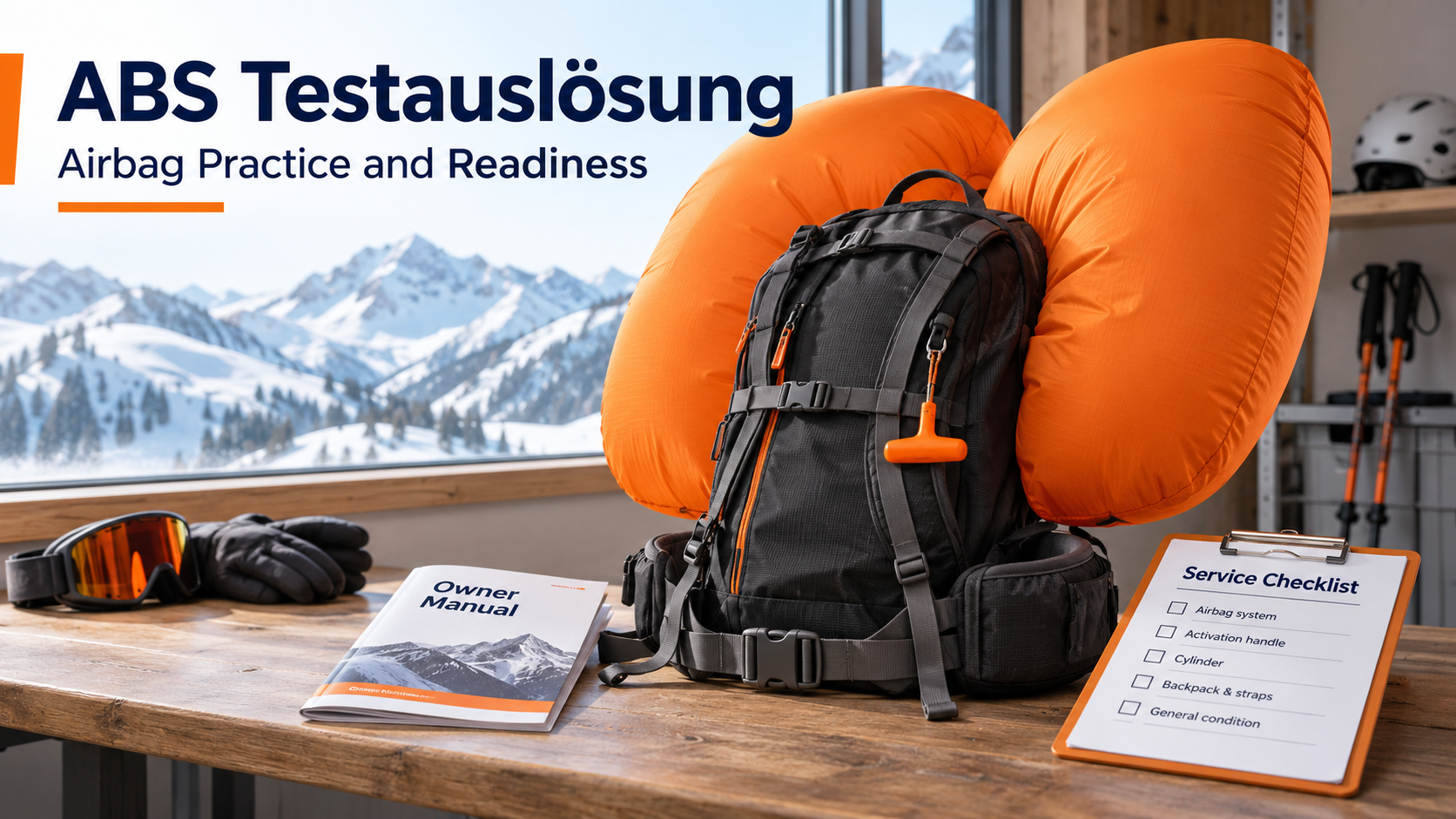
ABS Testauslösung means a practice deployment of an ABS avalanche-airbag system. Its purpose is to check the equipment and rehearse the action needed to activate it. ABS recommends a training deployment before the season, but the correct preparation and reset depend on the particular system, cartridge and trigger unit.
The useful starting point is therefore the model label, rather than a generic online demonstration. An older cartridge-operated pack and a newer system can have different components and servicing requirements. Plan the exercise early enough to restore the pack to a ready condition before travelling, and use the instructions supplied for that exact equipment.
What an ABS Testauslösung Checks
The manufacturer’s FAQ describes a seasonal practice deployment as both a function check and a way to train the movement towards the activation handle. These are distinct benefits. Watching an airbag inflate is useful, but so is discovering whether the wearer can find and operate the correct control without hesitation.
A successful exercise should not be expanded into a guarantee about every future emergency. It records what happened with that particular setup on that occasion. Damage, incorrect packing, expired components or later changes to the equipment can alter readiness. Treat the result as one part of preparation rather than a permanent certificate of safety.
The test also creates an opportunity to resolve uncertainty while help is available. If the label, service history or compatibility of a component is unclear, ask the manufacturer or an authorised service provider before attempting a deployment. An unfamiliar connection is a reason to check the manual, not to improvise an adapter or force a component into place.
Identify the System Before Following Instructions
ABS maintains a download library with separate manuals for products including A.LIGHT, A.LIGHT TOUR, A.LIGHT GO, A.LIGHT E, s.Light, s.Cape, p.Ride and Solid. The existence of separate documents matters: the brand name alone is not a complete operating specification.
Find the product designation on the pack and compare it with the manual heading. Check which activation unit belongs to it, which components are reusable, and what must happen after deployment. If the pack has changed hands, confirm that the supplied documents actually match the equipment rather than relying on whatever booklet was included in the sale.
A written equipment record is helpful for this purpose. Note the pack model, component identifiers, relevant dates and the last service or practice deployment. Keep photographs of labels for your own records. This is an organisational suggestion, not a substitute for the manufacturer’s inspection procedure or a claim that a homemade checklist proves the system is sound.
Plan the Reset Before Pulling the Handle
A practice deployment can consume a filled cartridge or require other restoration work. ABS offers a refill service for activation units and distinguishes what customers need to send for different systems. Its service page lists cartridge and handle for a Solid activation unit, the cartridge for an Easy Tech bottle, and the p.Ride inflator for the corresponding option.
Those differences are a practical reason to arrange service before the test. Check the current booking process, dispatch instructions and expected turnaround with the relevant service centre. A pack that has just been successfully deployed is not automatically ready to be carried into avalanche terrain the next morning.
Keep the service confirmation with the equipment record, and inspect the returned components against the order. If the item received differs from the unit you expected, resolve that question before reassembly. Availability, shipping conditions and service arrangements can change, so an old forum post should not be treated as the current process.
Component Dates Need Their Own Check
ABS explains that cartridges and activation handles can have expiry or service-life limits. The date printed on the component is more useful than an estimate based on when you remember buying the backpack. A second-hand pack may contain a newer cartridge, while a recently purchased used cartridge may already have a substantial service history.
The manufacturer’s activation-handle information describes the handle as part of the activation unit and points users to a date on the side of the handle. Its guidance refers to replacement requirements for the integrated capsule. Read that information together with the current FAQ and the instructions for the actual unit, rather than assuming that every generation follows an identical maintenance rule.
If two documents appear inconsistent, send the model and component details to ABS and ask which instruction applies. Do not choose the longer interval simply because it is more convenient. Equally, do not discard usable equipment solely because a rule for a different system appeared in a search result.
Use a Controlled Practice Setting
Choose a setting suitable for the exercise described in the manual, with enough room for the equipment to deploy and for other people to remain clear. Read the warnings before beginning. A practice session should not involve a real avalanche slope or an attempt to reproduce a dangerous emergency.
Consider the clothing and carrying arrangement you intend to use, because the physical location of a handle is part of the training question. The aim is to identify an awkward fit or a misunderstanding in a controlled setting. Any adjustment must remain within the manufacturer’s instructions; altering safety equipment to make a preferred carrying arrangement work can introduce new problems.
After the exercise, follow the specified deflation, inspection and repacking procedure. If something did not behave as expected, record the observation clearly and contact the service provider. Repeating a failed test without understanding the cause can consume components while leaving the original uncertainty unresolved.
Airbag Practice Is Only Part of Avalanche Preparation
The Swiss Institute for Snow and Avalanche Research explains the limits of equipment and forecasts. It identifies a transceiver, shovel and probe as standard emergency equipment and recommends an avalanche airbag in addition. Training in how to use the equipment remains necessary.
A practice inflation does not make an unsafe route acceptable. Avalanches can cause impact injuries, carry people over terrain features and create dangers beyond burial. Route selection, current conditions, observations on the ground and the group’s experience remain central decisions.
The SLF’s avalanche-prevention guidance also stresses education and appropriate behaviour. People who cannot assess avalanche danger should not treat ownership of an airbag as a substitute for the knowledge required to leave secured terrain. A qualified course or professionally guided outing answers a different need from a mechanical equipment test.
Do Not Confuse Practice With Post-Accident Service
The ABS download page separately links a product-service process for equipment used in an avalanche. That distinction is important. A clean indoor test and an actual accident can expose equipment to different stresses, contamination and damage.
If a pack has been involved in an avalanche or another significant incident, explain that history to the manufacturer. Do not assume that refilling a cartridge alone resolves every possible issue. The appropriate inspection and return-to-service decision depend on the circumstances and the equipment involved.
Frequently Asked Questions
What does Testauslösung mean?
It means a test or practice activation. In this context it refers to deploying an ABS avalanche airbag under controlled conditions, following the instructions for the specific system.
How often does ABS recommend practising?
Its FAQ recommends a training deployment before the season. Check the current manual and service requirements for your particular pack and activation unit before arranging the exercise.
Can I use any replacement cartridge?
Do not assume compatibility from appearance or thread size. Use the components specified for the system and confirm uncertain combinations with ABS or an authorised service provider.
Is the pack ready immediately after a test?
Not necessarily. The activation unit may need refill or replacement work, and the airbag must be inspected and repacked according to its manual before use.
Does an airbag replace a beacon, shovel and probe?
No. Avalanche-safety authorities treat those items as standard rescue equipment. An airbag is an additional measure, and neither equipment ownership nor successful practice replaces avalanche education and sound route decisions.
