


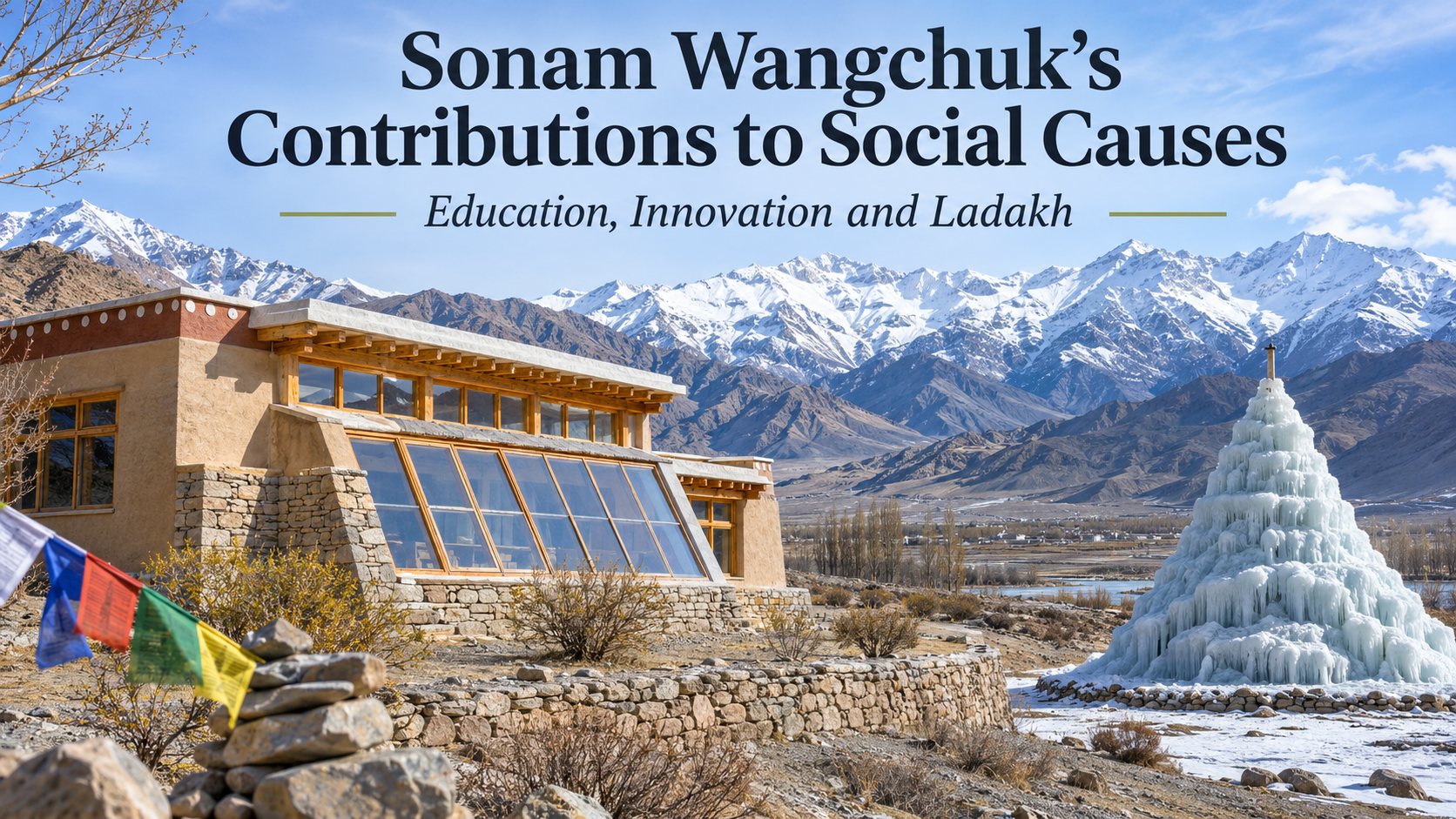
Sonam Wangchuk’s contributions to social causes centre on education reform, practical environmental innovation and the development priorities of Ladakh. His best-documented work connects learning with local needs: helping young people build confidence, improving educational materials, demonstrating solar-heated buildings and developing approaches to seasonal water storage.
These contributions are easier to understand through the institutions and projects involved than through a list of inspirational claims. SECMOL, the Himalayan Institute of Alternatives, Ladakh, and the Ice Stupa initiative address related problems, but they are not interchangeable organisations. Their own records also make clear that students, teachers, communities and project teams contribute to the work.
Sonam Wangchuk’s Contributions to Social Causes: The Main Areas
Wangchuk is an educator and innovator associated with Ladakh, a high-altitude Himalayan region. The Ramon Magsaysay Award Foundation’s profile recognises his collaborative approach to education and the use of science and culture to improve opportunities for Ladakhi youth. He received the award in 2018.
The strongest recurring theme is practical relevance. A classroom should equip learners to understand their surroundings; a building should respond to its climate; and a water project should address when a farming community actually needs water. This connects his educational work with environmental problem-solving rather than treating them as separate charitable activities.
SECMOL and Education Rooted in Ladakh
The Students’ Educational and Cultural Movement of Ladakh, known as SECMOL, says it was founded in 1988 by a group of young Ladakhis seeking reform in the region’s education system. Wangchuk’s contribution belongs within that collective history. Describing the organisation as the achievement of one person alone would erase its other participants.
SECMOL’s account of its approach describes a residential learning community that combines academic knowledge with practical, environmental, social and cultural skills. Students learn Ladakhi songs, dance and history alongside other subjects, and take substantial responsibility for running and maintaining campus life.
This model addresses more than examination preparation. Daily responsibilities create opportunities to practise communication, planning and cooperation. Connecting learning with a familiar language, landscape and culture can also challenge the assumption that a student’s background is an obstacle to education rather than a source of knowledge.
Operation New Hope and School Reform
SECMOL’s history of education reform identifies Operation New Hope as a movement launched in 1994 with the Education Department, local government and village communities. Its work concerned the wider school system, not simply a single alternative campus.
The organisation describes reforms involving teacher training, locally relevant materials, clearer language arrangements and greater community involvement in schools. These are concrete institutional changes. They are more informative than a broad statement that an individual “transformed education,” which can conceal what changed and who helped implement it.
SECMOL also states that it withdrew from working with local government on school reform in 2007. That date matters when discussing present responsibilities. A historical contribution to a programme does not establish that Wangchuk or SECMOL still controls its administration, staffing or results today.
Textbooks That Reflect Students’ Surroundings
One tangible part of the education work is the development of learning materials. SECMOL’s publication catalogue lists schoolbooks and bilingual stories produced in connection with Operation New Hope. The catalogue identifies collaborations involving Ladakhi teachers, SECMOL, Eklavya and public education bodies.
For example, its Class 4 environmental-studies materials cover science and social science for children in Ladakh. The catalogue also includes early English readers and stories in Ladakhi and English. These publications demonstrate how education reform can involve the content children encounter, not only the teaching method used in a classroom.
Local relevance does not mean rejecting knowledge from elsewhere. It means giving learners an accessible route into that knowledge. A lesson that begins with a recognisable environment can help students connect a new concept to an experience they can discuss and examine.
Passive Solar Buildings as a Learning Resource
SECMOL’s buildings illustrate the link between environmental design and education. Its passive-solar explanation describes collecting sunlight, retaining heat through building design and using thermal mass and insulation. This differs from simply adding an electric heater or a photovoltaic panel to an otherwise unchanged building.
The campus uses features such as south-facing windows and earth construction suited to its setting. These are documented examples from the institution’s own buildings, not a guarantee that copying one detail will produce the same results in another climate. Orientation, construction quality, local conditions and the complete design all matter.
The social contribution is partly demonstrative. Students can learn from a building they occupy and help maintain, rather than encountering energy only as an abstract topic. The project links comfort, local materials, resource use and practical skills in an everyday setting.
Ice Stupas and Seasonal Water Availability
The Ice Stupa approach stores winter water as ice so that some of it can become available during a later planting period. Wangchuk and collaborators helped develop and publicise the cone-shaped structures. The award foundation describes this work as a response to the timing of water availability for agriculture.
HIAL’s Ice Stupa automation overview explains ongoing interest in monitoring and controlling water flow to improve how these structures operate. It presents automation as part of development, not proof that every installation already works identically or that local water scarcity has been eliminated.
Storage is not the creation of a new water source. A project still depends on available water, sufficiently cold conditions, suitable infrastructure and maintenance. Its value has to be assessed against the needs and results of the particular community rather than inferred from a striking photograph of an ice cone.
HIAL and Learning Through Real Problems
The Himalayan Institute of Alternatives, Ladakh identifies Wangchuk as its founding director and Gitanjali J B as co-founder and chief executive. Its public introduction emphasises a combination of intellectual understanding, empathy and practical skills.
That approach extends the connection between education and community needs. A real problem can require knowledge from several disciplines, as well as cooperation with people affected by it. The educational value lies in understanding constraints, testing an approach and learning from results, rather than treating an invention as complete at the moment it is announced.
Readers evaluating a particular course should separately check its current programme, admissions arrangements and qualification details. An institution’s educational philosophy does not by itself establish the accreditation or professional recognition of every offering associated with its name.
Public Advocacy and the Importance of Dates
Wangchuk’s public profile also includes advocacy concerning Ladakh’s environment and political safeguards. That work has attracted both support and government scrutiny. Reporting should distinguish his stated causes, the authorities’ position and independently established legal events.
A significant documented update came on 14 March 2026. The Ministry of Home Affairs announced through the Press Information Bureau that his detention under the National Security Act was being revoked with immediate effect. The release says the detention began on 26 September 2025 and presents the government’s explanation of the decision.
An older article describing that detention as continuing should therefore not be presented as an up-to-date account without considering the March announcement. Equally, a revocation should not be expanded into a claim that every disagreement or legal question has been resolved. The document establishes a specific decision on a specific date.
How to Assess the Lasting Contribution
The most useful assessment looks at what communities and learners can continue doing: using relevant educational materials, participating in institutions, understanding their environment and testing practical solutions. Awards provide recognition, but programme records, collaborators and observable outcomes explain how the work functions.
This avoids two common distortions: attributing every improvement in Ladakh to a single individual, or reducing a long educational career to its latest controversy. Wangchuk’s documented contribution lies in connecting social opportunity with local knowledge and practical experimentation, while the performance of each project still deserves its own evidence.
Frequently Asked Questions
What is Sonam Wangchuk best known for?
He is known for education reform associated with SECMOL, environmental innovation including Ice Stupas, and his role as founding director of HIAL. His work is closely connected with Ladakh.
Did he establish SECMOL alone?
No. SECMOL describes its founding in 1988 as the work of a group of young Ladakhis. Wangchuk’s role should be understood within that collaborative institutional history.
What social problem do Ice Stupas address?
They address a seasonal mismatch in water availability by storing winter water as ice for later use. They do not create water or remove every cause of agricultural water scarcity.
Which major award did he receive?
He received the 2018 Ramon Magsaysay Award. The foundation recognised his community-driven education reform and constructive use of science and culture to improve opportunities.
What changed in March 2026?
The Ministry of Home Affairs announced on 14 March that his detention under the National Security Act was being revoked immediately. That dated decision should be distinguished from older reports and from other questions about his advocacy.
