


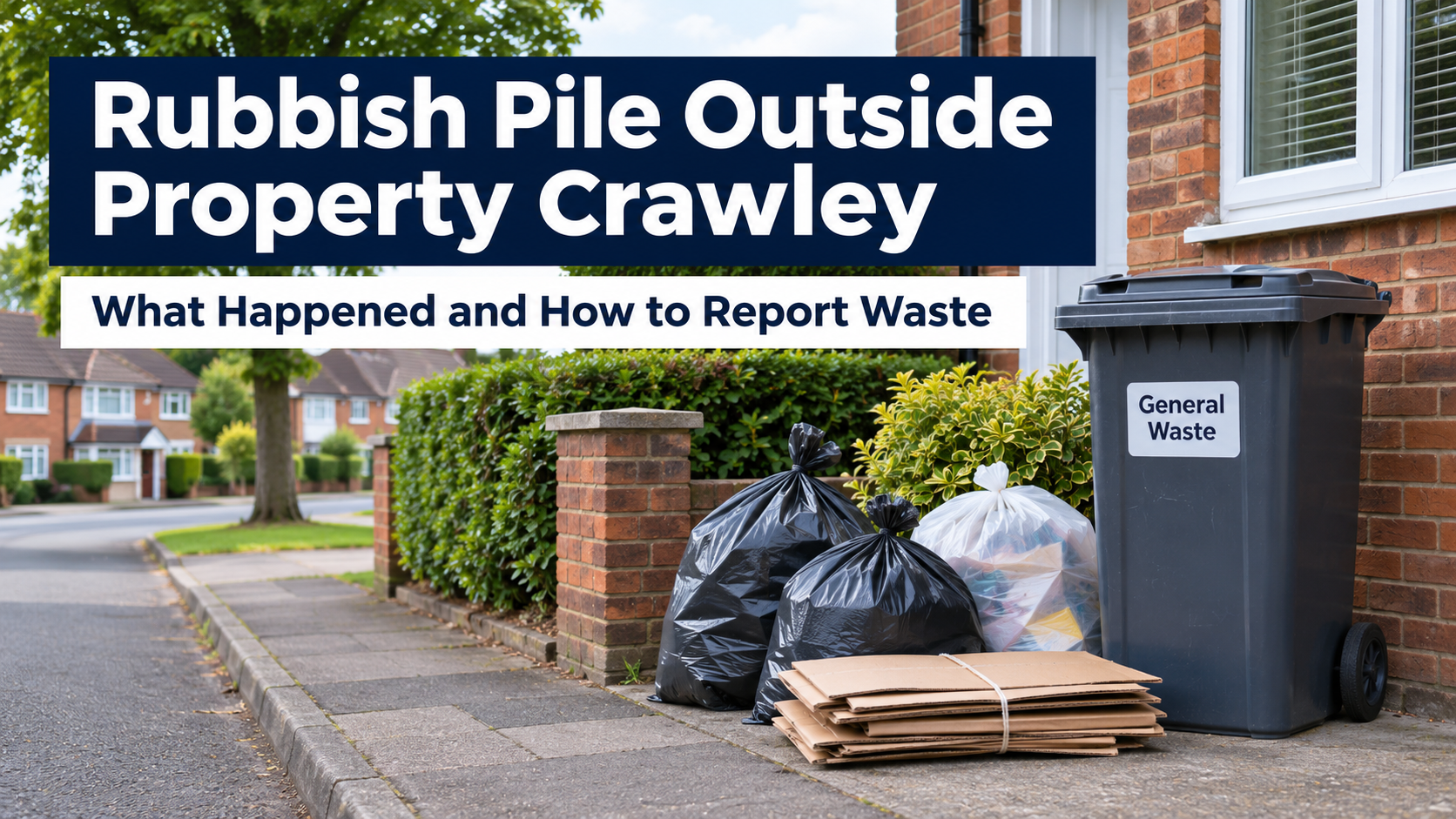
The rubbish pile outside property Crawley searches refer to an August 2025 incident in Britten Close, where a large accumulation of waste drew Crawley Borough Council’s attention. Local follow-up reporting said the rubbish was cleared. It should therefore be described as a documented historical incident, rather than a confirmed ongoing problem at the property.
The case also raises a practical question for residents: how do you report an accumulation of waste, arrange an appropriate collection and check a private clearance company? The answers depend on the location, ownership and type of waste. A photograph alone does not establish who deposited it, whether an offence occurred or which service is responsible.
What Happened in the Rubbish Pile Outside Property Crawley Case?
The Argus’s original report described a substantial pile outside a home in Britten Close. It reported that the council had been notified on Sunday night and intended to visit the property. The published council response said it expected the rubbish to be cleared.
A follow-up published on 13 August 2025 recorded that the pile had been removed. The original reporter’s publication archive also identifies that follow-up and reproduces its basic council-response context. These are dated reports about a particular event, not a notice that waste remains there today.
The public material reviewed does not establish a prosecution, a particular fine or the identity of whoever deposited every item. Nor does the clearance establish who paid for it. Those are separate claims that would need their own reliable evidence, rather than assumptions based on the size of the pile.
Separate the Incident From General Fly-Tipping Rules
People often use “dumping,” “rubbish accumulation” and “fly-tipping” interchangeably in conversation. For reporting, however, the circumstances matter. Waste deliberately abandoned on a public route, items awaiting an agreed collection and an accumulation inside a private boundary can require different investigations or services.
Crawley’s street-care guidance provides a reporting route for fly-tipping and other street problems. Using that route gives officers a location and a description to assess. It does not mean the person making the report must identify an offender or decide which enforcement power applies.
Describe what can actually be observed: the approximate location, the kind of items, whether access appears blocked and when the problem was noticed. Keep observations separate from conclusions about a neighbour’s conduct. That produces a more useful report and avoids repeating an unsupported allegation about an identifiable household.
What to Include When Reporting Waste
A precise location is more useful than a dramatic description. Give the street and a clear reference point, and explain whether the material appears to be on a pavement, road, communal area or within a property boundary. If there is an existing council reference, retain it for follow-up instead of creating several disconnected accounts of the same problem.
Photographs can show the scale and position without proving how the waste arrived. Where a reporting form accepts them, provide images that help officers find and assess the material. Avoid publishing residents’ personal details or treating social-media speculation as an official finding.
Do not handle unfamiliar waste simply to improve a photograph or look for evidence. A description can identify a suspected concern without opening bags or moving items. Report immediate dangers through the appropriate emergency route; a routine street-care form is intended for matters that can wait for the responsible team’s assessment.
When the Council’s Bulky-Waste Service Fits
The council’s bulky-waste service covers eligible household items that do not fit in an ordinary bin. Its published information includes a maximum of ten items per collection and explains that charges depend on the items involved. Check the current booking information rather than relying on a fee copied from an old news story.
The advertised service is not a general house-clearance or commercial-waste service. The page distinguishes ordinary household items from excluded materials and other collection routes. A resident planning a large clearance should therefore identify the actual waste before choosing a service, rather than booking the smallest collection and assuming everything outside will be taken.
Availability, access and preparation requirements also matter. Explain what needs collecting and follow the arrangements confirmed for that booking. Keep agreed items identifiable and avoid mixing additional unbooked material into the same pile, which can create confusion for the collection crew.
Preparing an Agreed Collection
The council’s published bulky-waste terms explain that only specified items are collected and that they must be suitable for the service’s handling arrangements. They also address changes, cancellations and situations where an item is not collected. Read the current terms alongside the booking confirmation because operational details can change.
In practical terms, make a simple list before booking. Identify each item, its condition and any access issue that needs explaining. A sofa, loose building rubble and garden cuttings are different waste streams even when they are all being removed during the same household project.
If a collection does not happen as expected, use the contact and reporting instructions in the booking information. Keep the confirmation and any reference number. Assuming that an uncollected item has become somebody else’s responsibility can leave the underlying disposal problem unresolved.
Checking a Private Waste-Clearance Company
Crawley’s private waste-disposal guidance advises residents to check a carrier’s registration and obtain appropriate paperwork. A low price, a friendly recommendation or a photograph of a van does not by itself establish that the operator is authorised to transport waste.
The council sets out the SCRAP approach: question unexpected offers, check registration, ask where the material will go and retain a receipt or other proper record. The purpose is to understand the disposal arrangement before the waste leaves, rather than trying to reconstruct it after a complaint or investigation.
Ask the contractor to identify the business performing the work and describe what is included in the price. A quote should make clear whether collection, transport and disposal are covered. If the explanation is incomplete, resolve those points before agreeing to a clearance rather than treating an online advertisement as a complete contract.
Reuse and Recycling May Offer Better Routes
West Sussex County Council’s waste-prevention guidance points residents towards local recycling centres, suitable council collections and donation of usable items. The right option depends on condition and material. An intact item that another household can use presents a different question from broken or contaminated waste.
Plan the route before a large clear-out begins. Check the relevant facility’s booking and acceptance rules, allow for separate materials and avoid assuming that one vehicle trip can take every item. For paper-based material, our cardboard and recycling guide explains why coatings and intended use can change a disposal decision.
The lesson from the Crawley report is therefore practical rather than accusatory: establish the facts, use the correct reporting route and arrange a disposal service that matches the actual waste. The historical clearance is documented; broader claims about current conditions or individual wrongdoing need new evidence.
Frequently Asked Questions
Where was the reported Crawley rubbish pile?
The August 2025 local reports concerned a residential property in Britten Close, Crawley. A street-level description is sufficient to explain the news story without repeating unnecessary identifying details.
Was the rubbish cleared?
Yes. The Argus published a follow-up on 13 August 2025 stating that the large pile had been cleared. The reviewed evidence does not establish that the same problem is ongoing.
Was a resident fined over the incident?
The sources reviewed do not establish a specific fine or prosecution arising from this case. General enforcement powers should not be presented as proof of a particular outcome.
Can Crawley collect everything from a house clearance?
Not through the ordinary bulky-waste service. It has eligibility and item limits, and excludes commercial waste and various materials. Check the published service conditions before booking.
What should I check before paying a private collector?
Check the operator’s waste-carrier registration, ask how the material will be disposed of and obtain proper paperwork. Keep the booking and payment records so the arrangement can be traced if necessary.
