


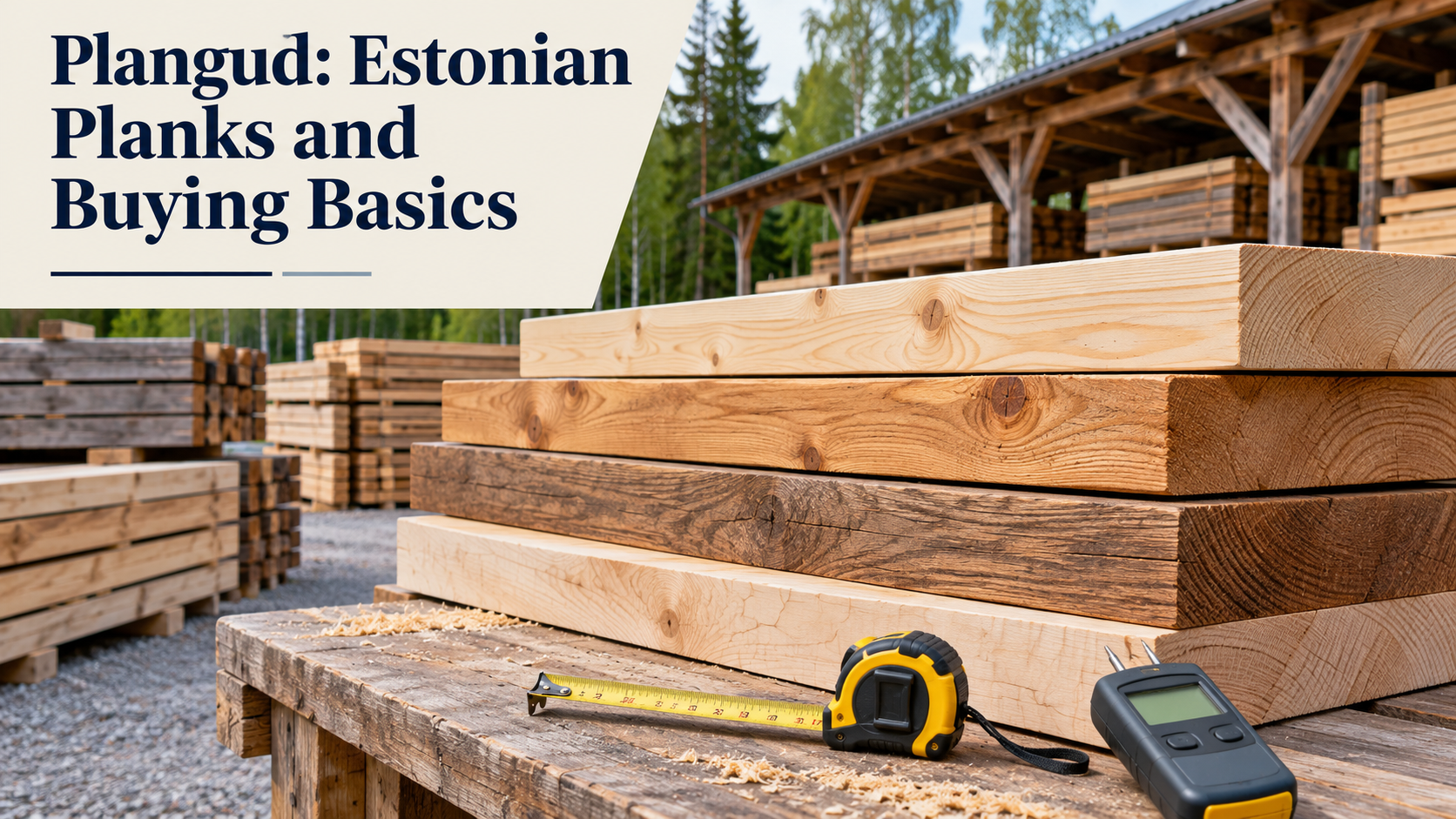
Plangud is an Estonian plural form of plank, meaning wooden planks or substantial boards. It is useful vocabulary when reading timber listings, but the word alone does not identify a species, structural grade, moisture condition or ready-to-use building product.
For an English-speaking buyer, the main task is therefore both linguistic and practical. Translate the noun correctly, then read the specification that follows it. A stack of rough-sawn boards, finished flooring and timber intended for a load-bearing structure can require very different checks even when a seller uses a familiar word for wood.
What Plangud Means in Estonian
The Institute of the Estonian Language’s Sõnaveeb entry lists plangud among the forms of plank. Its dictionary material associates the word with a thick board sawn from a tree trunk, while its terminology records also provide English equivalents connected with planks and boards.
The entry shows other forms, including plangu, plankude and planku. Those differences reflect Estonian grammar, not separate timber brands. Someone searching only the plural may miss a catalogue that uses another grammatical form in a heading or description.
Do not confuse the resemblance to the English word “plan” with evidence of a productivity system. In the documented language context, the word belongs to timber vocabulary. If an unrelated website uses Plangud as a name, its services would need to be established separately rather than inferred from this dictionary meaning.
Translation Is Only the First Step in Buying Timber
A generic material name cannot tell you whether a board is suitable for a particular job. The US Forest Service’s Wood Handbook treats wood properties, grading, moisture, preservation and finishing as distinct subjects. That separation is a useful model for reading a product listing.
Begin by defining the end use. Furniture, internal trim, a garden project and a structural member do not present the same requirements. Describe the intended environment and any load-bearing function to the supplier before asking which stock is appropriate.
Then separate appearance from performance. An attractive grain or clear surface may matter for a visible shelf, but it is not a substitute for the required grade in a structural application. Equally, a board that meets a structural requirement may not have the finish a furniture project needs.
Check Species, Grade and Processing
Ask the seller to identify the wood species and the way the material has been processed. A listing may refer to rough-sawn, planed or profiled stock, and those descriptions affect how much work remains before installation. The species name and product description should appear consistently on the quotation and delivery documents.
Where a grade is specified, ask which grading system is being used and what the designation covers. A grading term meaningful in one market should not automatically be treated as equivalent to a familiar grade from another country. For a regulated or engineered use, the responsible designer needs to confirm the applicable requirements.
It also helps to distinguish solid timber from products assembled from smaller pieces or other wood-based materials. A broad translated heading can conceal important differences in construction. Request the actual product description rather than selecting solely from a photograph of a wooden surface.
Dimensions: Compare What Will Actually Arrive
Record thickness, width and length in a consistent unit. Confirm whether the quoted dimensions describe the rough material, a nominal size or the finished section. If machining remains to be done, establish whether there is enough allowance to reach the dimensions required by the project.
For example, a buyer planning a fitted component needs to know the usable finished dimensions, not merely the size of the original rough board. This is an illustrative planning issue, not a universal machining allowance. The amount that can be removed depends on the stock and intended result.
Length deserves a separate check. Ask whether a bundle contains identical lengths or a stated range, and whether the price is per piece, metre or volume. Two offers cannot be compared fairly until the quantity and basis of measurement are clear.
Moisture Changes the Practical Result
Wood interacts with moisture in the surrounding environment. The Forest Service’s chapter on moisture relations and physical properties explains the relationship between moisture and dimensional behaviour. This is why a board’s condition at delivery matters alongside its dimensions.
Ask whether the timber is green, air-dried or kiln-dried and whether a moisture range is specified. Those descriptions are not interchangeable promises that the material is ready for every indoor or outdoor job. The target condition depends on where the timber will be used.
The handbook’s separate chapter on drying and moisture control addresses preparation and dimensional changes in more detail. For a project where movement would cause expensive problems, obtain appropriate technical advice and follow the product’s installation requirements rather than relying on a generic acclimatisation period found online.
Inspect Condition Before Accepting a Delivery
Compare the delivered material with the written order. Check the quantity, section and lengths, then look for condition issues that affect the intended use. Photographs taken at delivery can help document an obvious discrepancy, but they should be accompanied by a clear description of what was ordered.
Not every visible characteristic is necessarily a defect. Knots, colour variation and other features may fall within the agreed description or grade. The useful question is whether the material meets the specification, rather than whether every board looks identical to a promotional photograph.
If something appears wrong, identify the affected pieces and contact the supplier before cutting or installing them. Keep the packaging label and delivery paperwork where available. That gives both sides a better basis for resolving the issue than a general complaint that the wood “looks different.”
Responsible Sourcing Needs Evidence
Wood’s natural origin does not by itself establish how it was sourced. When a seller makes a certification claim, ask which material and documents the claim applies to. A logo on a general company webpage is not automatically a claim covering every product it sells.
FSC’s chain-of-custody explanation describes how eligible material is identified and handled through the supply chain. Its role concerns sourcing claims, rather than proving that a particular board is suitable for a structural design or resistant to every outdoor condition.
Keep those questions separate in the purchase brief. Sourcing evidence, engineering suitability, durability and appearance each answer a different part of the decision. One certificate or attractive description should not be expected to do all four jobs.
Build a Useful Enquiry Before Requesting a Price
A practical enquiry states the intended use, environment, required dimensions, quantity, preferred species and any design or certification requirements. Include whether you need planing, profiling, treatment, delivery or installation. This makes it easier for suppliers to quote comparable work.
Ask what is excluded and how substitutions will be approved. A replacement species or different finished thickness may change the outcome even if the price remains similar. Written confirmation is especially useful when communicating across languages and when the translated product name is broader than the actual specification.
Frequently Asked Questions
Does Plangud mean wooden planks?
Yes, in the documented Estonian vocabulary it is a plural form of plank. The dictionary context concerns substantial wooden boards, not a specific manufacturer or software product.
Is every item described as Plangud structural timber?
No. The word does not establish structural grading or suitability. The required grade and product evidence must be checked for the actual design and location.
Does kiln-dried mean ready for every project?
No. Ask for the stated moisture condition and follow the requirements for the intended environment. Drying method alone is not a complete installation specification.
Why might listed and finished dimensions differ?
A listing may describe rough or nominal stock rather than the finished section. Confirm the measurement basis and any remaining processing before comparing offers.
Does an FSC claim replace a timber grade?
No. Chain-of-custody certification concerns the sourcing claim. Structural grading, product suitability and installation requirements remain separate checks.
