

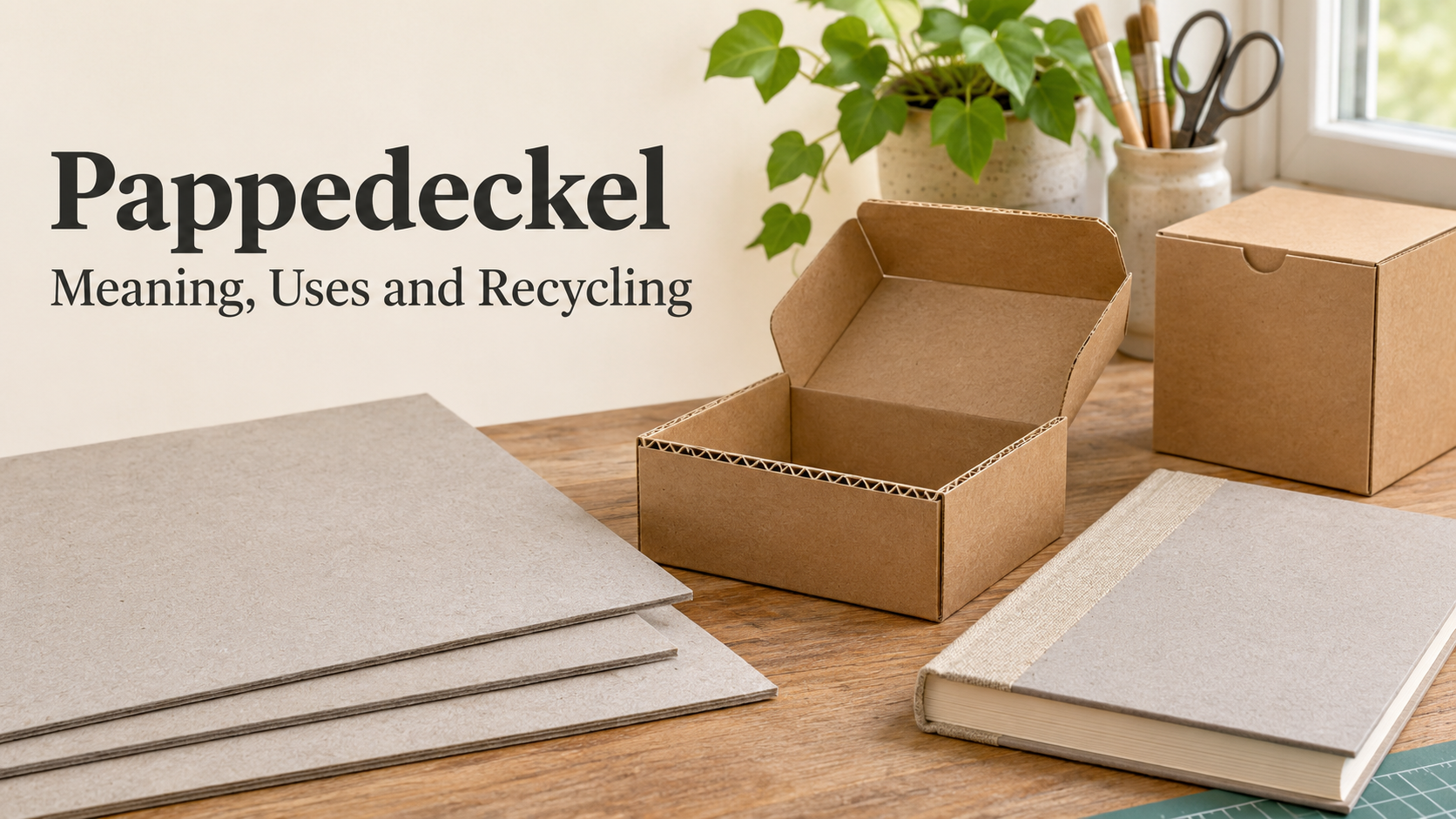
Pappedeckel is a regional German word associated with cardboard or a cardboard box. It is recorded in an Alemannic dialect lexicon, while the related standard spelling Pappendeckel refers to a piece of stiff cardboard. The right English translation depends on whether the speaker means the material, a flat board or a finished container.
That distinction is useful when reading a local advertisement, interpreting a craft instruction or buying packaging. The word does not identify a particular brand, patented material or certified environmental product. To understand what an actual item can do, look beyond its name to its construction, condition and intended use.
What Does Pappedeckel Mean?
The Alemannische Seiten regional lexicon records “Pabbedeggel, Pappedeckel” with the German equivalent Karton and the English translation “cardboard box.” It also notes a local figurative use for a driving licence. These are documented language usages, rather than evidence of a recently invented packaging technology.
Context resolves the meaning. If someone is discussing moving house, a cardboard box is a plausible translation. If a craft instruction describes cutting a flat rectangle, cardboard or board is more useful. If the surrounding conversation concerns a driving licence, a literal translation involving a box would miss the intended regional expression.
Pappedeckel, Pappendeckel and Pappdeckel
Duden lists Pappendeckel as a masculine noun meaning a piece of cardboard and identifies Pappdeckel as a related form. The dialect spelling and the standard dictionary entry therefore belong in the same language discussion, but they should not be presented as perfectly interchangeable labels in every situation.
The final element Deckel can suggest a lid to an English learner. However, the complete word has an established meaning of its own. Translating every occurrence as “cardboard lid” would be too restrictive, particularly when the source clearly describes a sheet or an entire carton.
For formal product specifications, use the material name and measurements supplied by the manufacturer. For translation, preserve the meaning of the sentence. A memorable regional expression is valuable cultural information, but it is not a substitute for a technical description.
Identify the Material Before Choosing a Use
Cardboard is an everyday category rather than a guarantee that every piece behaves identically. A flat, dense board differs from a sheet with a visible corrugated layer. A folding retail carton differs from a rigid storage box. The outer surface can hide these differences until an edge or opening is examined.
Start by looking at the construction. A cut edge may reveal several layers or a wavy inner section. Check whether the item is a sheet, a folded box, a fitted lid or a laminated composite. Then read any specification that accompanies the product instead of assuming that brown colour or apparent thickness proves a particular strength.
For a purchased shipping box, the supplier’s stated application and any relevant load information matter more than the regional word used in an advert. This guide does not assign an invented weight limit to generic cardboard. Two similar-looking boxes can have different dimensions, damage histories and closure systems.
Practical Uses for Clean Cardboard
For non-food household tasks, sound cardboard can serve as a divider, a temporary template, a model-making material or a protective separator. A flat piece can help plan the outline of an object before a more expensive material is cut. Small boxes can organise light items when their size and condition suit the job.
Consider a drawer divider as an example. Measure the usable internal space, account for existing hinges or runners and decide which objects need separating. A trial divider made from an offcut can reveal a poor layout before anything permanent is built. This is an illustrative use, not a claim that every cardboard grade is suitable for long-term furniture construction.
A reusable carton also needs to remain functional. Remove obsolete delivery details where appropriate, check that the base and corners remain intact and confirm that the new contents fit. A box that requires extensive reinforcement or no longer closes cleanly may be a poor choice for another journey.
Measure Fit, Not Just the Outside
Packaging dimensions can describe different things. Internal measurements determine whether an object fits; external measurements determine how much space the package occupies. A lid, insert or folded wall may reduce the usable space. Ask which measurement a listing provides if the distinction is unclear.
Allow for whatever protection the item actually requires. A carton that fits the bare object exactly may leave no room for a suitable insert. Conversely, an oversized box can let an object move unless the packing arrangement prevents it. The right choice depends on the object and the complete packaging system, not on the cardboard label alone.
For a craft project, a small trial piece is often more informative than an assumption about flexibility. Check whether the board folds cleanly, whether a proposed adhesive affects its surface and whether the finished arrangement will fit its intended location. Do not interpret a successful decorative model as a test of structural load-bearing performance.
Food Packaging Needs Its Own Evidence
Cardboard used around food needs to be assessed for that application. A clean-looking recycled parcel box is not automatically suitable for direct contact with a sandwich or cake. Printing, coatings, earlier contents and the type of food can all matter.
The German consumer advice guidance on paper and cardboard food packaging explains that these materials can involve coatings and other substances. Its discussion is a reminder to use packaging intended for the relevant food contact rather than treating every paper-based object as equivalent.
For a practical purchase, ask whether the product is intended for the food, temperature and contact conditions involved. Follow the manufacturer’s stated limitations. The word Pappedeckel does not itself establish food-contact suitability, grease resistance or permission to heat an item in an oven or microwave.
Can Pappedeckel Go in Paper Recycling?
Often, ordinary emptied cardboard packaging belongs in paper collection, but the material and local rules determine the answer. Germany’s Federal Environment Ministry’s paper-recycling guidance includes paper, cardboard and carton packaging and stresses that food cartons must be emptied.
The same guidance excludes several other products, including liquid cartons and various waxed or specially treated papers and boards. This is why a container that looks mostly like paper should not automatically be assigned to the paper bin. Inspect the complete object and consult the collection authority’s instructions.
Those German examples should not be copied as universal bin-colour rules. A reader elsewhere may have different municipal arrangements. Check the local scheme for coated packaging, food contamination and any components that can be separated. Sorting correctly is more useful than relying on a broad claim that all cardboard is recyclable everywhere.
For a different packaging format, see our guide to smoothie pouches and their reusable or single-use designs. A flexible pouch and an ordinary paperboard box can require different cleaning and disposal decisions even when both are sold around food.
Common Claims Worth Questioning
A regional name does not prove that an item is a traditional handmade product. A brown surface does not establish recycled content, and a paper-based appearance does not guarantee that an object is uncoated. Similarly, “natural” and “eco-friendly” are descriptions that need supporting product information if they are meant to guide a purchase.
Look for specific, relevant statements: dimensions, material composition, intended application and disposal guidance. For an everyday storage or craft task, these details help you choose a suitable item without turning an ordinary word into an exaggerated promise about performance or sustainability.
Frequently Asked Questions
Is Pappedeckel a real German word?
It is recorded as a regional Alemannic form. Duden separately records the related standard form Pappendeckel. Use the spelling and meaning appropriate to the source and context.
Does it always mean a cardboard lid?
No. The regional entry translates it as a cardboard box, while the standard dictionary entry describes a piece of cardboard. A literal translation of the final syllable alone can be misleading.
Is every cardboard item suitable for food?
No. Use packaging intended for the relevant food-contact conditions and follow its stated limitations. An ordinary parcel box does not establish that suitability.
How should I choose a box or board?
Identify the construction, check internal dimensions and condition, and compare the supplier’s stated application with your actual task. Do not assume a generic name establishes a weight rating.
Can all cardboard be recycled together?
No. Coatings, composite layers, contents and local collection rules can change the correct route. Empty ordinary packaging and check the local authority’s guidance for exceptions.
