


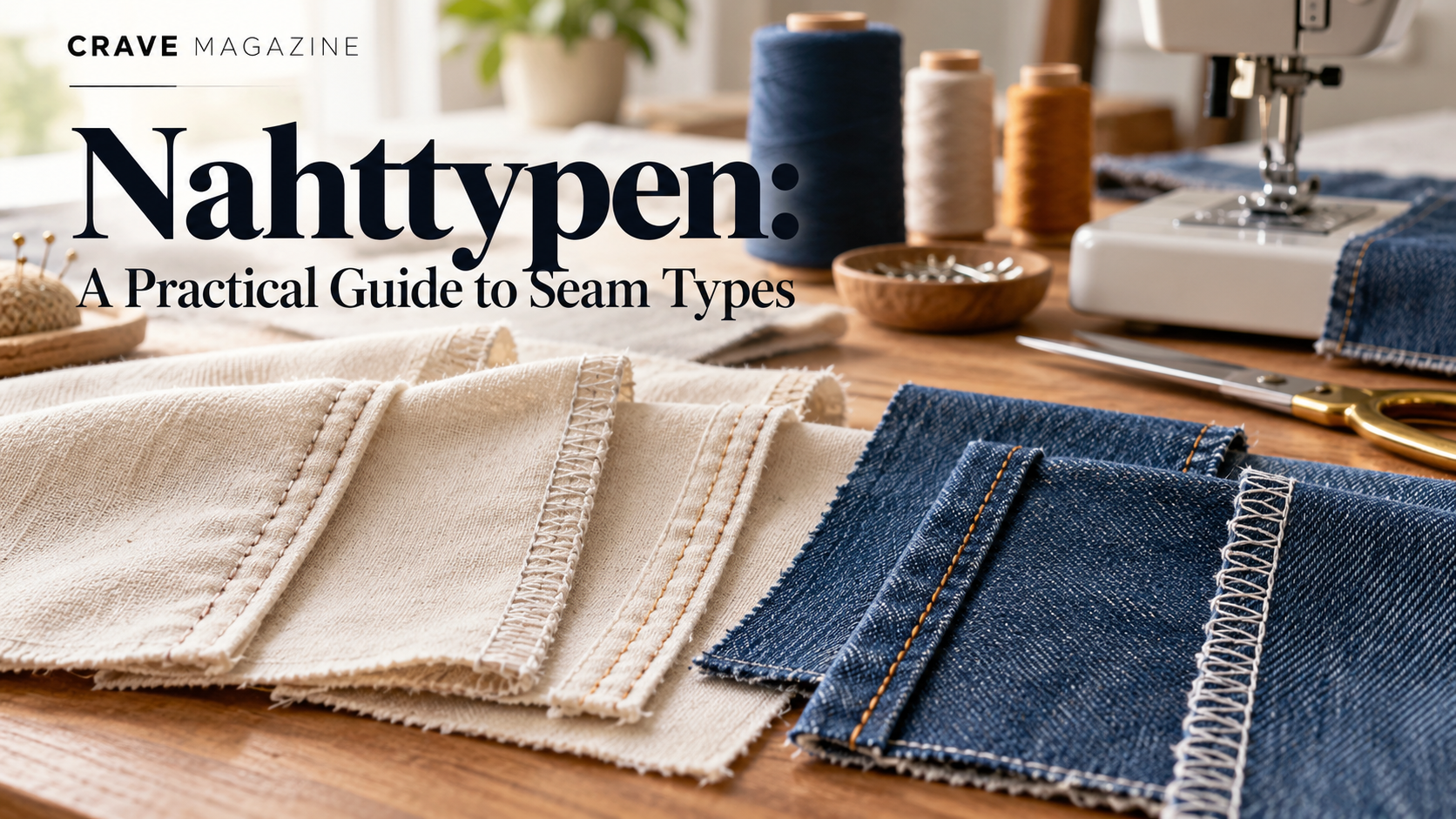
Nahttypen means seam types in German. In sewing, it describes how fabric pieces are arranged and joined, rather than simply the stitch selected on a machine. A plain seam, French seam and flat-felled seam can produce very different results even when the same basic straight stitch is involved.
The useful question is which construction suits the fabric, the garment and the equipment available. An enclosed finish can look beautiful inside an unlined blouse, while a bulky enclosed seam can be uncomfortable in a close-fitting garment. Understanding that tradeoff makes German sewing instructions easier to follow and helps explain why a seam that works on cotton may disappoint on jersey.
Nahttypen: Start With Construction, Stitch and Finish
These three ideas overlap, but they are not interchangeable. Construction describes the arrangement of the fabric layers. A stitch describes how thread connects those layers. A finish deals with exposed edges or the appearance of the completed work. A seam can therefore have a construction name, a stitch specification and an edge treatment at the same time.
The industrial thread manufacturer Coats distinguishes seam types by fabric arrangement and also notes their position in a finished garment. Superimposed seams place layers together; lapped seams overlap them; bound seams use an additional strip around an edge; flat constructions join edges in a different arrangement. These categories are more precise than treating every visible line of stitching as a separate seam type.
A practical example is a skirt side seam. Its location is the side of the skirt, its construction might be a conventional plain seam, and its raw edges might be overlocked. Calling it an overlocked side seam can be useful shorthand, but it does not tell you every detail needed to reproduce the construction.
Plain Seams: The Flexible Starting Point
A plain seam joins fabric pieces along a stitching line, usually with their right sides facing for the initial pass. The allowances can be pressed open or toward one side according to the pattern and design. Because the allowances remain accessible, this construction is useful when fitting adjustments may be needed.
Its simplicity should not be confused with an automatic clean finish. Fraying woven fabric still needs a suitable treatment at the cut edges. That could be a machine finish, binding or another method appropriate to the project. A lining may conceal allowances, but concealment alone does not stop an unstable edge from fraying during handling.
For a beginner, a plain seam is a good control sample. Sew it first on scraps, check the intended allowance, and compare its drape with another construction. This gives a visible baseline for deciding whether an enclosed seam improves the project or merely adds work and thickness.
French Seams for an Enclosed Interior
A French seam encloses the raw edges within the seam itself. Its two-stage construction differs from an ordinary single pass, and the order matters. BERNINA’s French seam tutorial explains the enclosed result and provides an illustrated method that is more reliable than guessing from the name alone.
This finish is often attractive where the inside will be seen, particularly on lightweight woven projects. The enclosed edge produces a narrow, tidy interior without a separate strip of binding. However, the extra folding changes the thickness of the seam, so it should be tested on the actual material rather than selected purely because it sounds more professional.
Follow the pattern’s allowance and construction directions carefully. Substituting a French seam without checking the available allowance can alter the finished dimensions. Tight curves, bulky fabric and intersections require particular attention because the folded fabric has to lie smoothly through every change of direction.
Flat-Felled Seams and Visible Structure
A flat-felled seam encloses the edges in a folded construction that lies toward one side. The additional stitching is often part of the finished appearance. BERNINA’s explanation of flat-felled seams uses familiar denim construction to show how the enclosed layers and visible stitching work together.
Choose it when that structured appearance suits the design and the machine can handle the combined layers. Think beyond a long straight section: pocket corners, cross seams and hems can create much thicker intersections. A neat test on two scraps does not automatically predict what the machine will do where several completed seams meet.
A mock flat-felled finish is a different construction. It can imitate part of the appearance without enclosing the allowances in exactly the same way. If a pattern specifies one version, do not assume the other has identical internal structure simply because the right side looks similar.
Bound Edges and Overlocking
Binding covers an edge with a separate strip. It can introduce a contrasting colour or create a considered interior on an unlined garment. The strip itself adds material, so a fine binding and a heavy binding do not behave alike. Test how the finished edge bends before committing to a full jacket or dress.
Overlocking uses thread around an edge and, depending on the machine and stitch setup, can finish or join material. A conventional sewing machine’s decorative imitation is not automatically the same as a serger construction. Check the machine manual, the selected stitch and the fabric’s need for stretch before treating those options as equivalent.
BERNINA’s beginner guide to seam finishes compares several approaches in a sample project. A sampler is especially useful because you can handle the results side by side. Appearance, flexibility and thickness are easier to assess in fabric than in a short product description.
Match the Seam to the Fabric
Start with the fabric’s behaviour. Does it stretch? Does its edge shed threads easily? Will the finished piece be translucent, washed frequently or worn against the skin? Those questions narrow the choice more effectively than a list ranking one seam as universally best.
Needle selection is another separate decision. SCHMETZ publishes fabric and needle recommendations covering woven fabrics, knits and specialised materials. Use those recommendations alongside the machine manual and fabric instructions. A suitable construction can still produce skipped stitches or damaged material when the needle is unsuitable.
For a sample test, use the intended thread and the same number of layers as the difficult section of the project. Press the sample as you would press the garment. Then examine both faces, gently handle it in the direction it will be stressed, and compare its flexibility with an unsewn scrap. Do not pull destructively and mistake that experiment for a certified strength test.
Read German Sewing Instructions Without Guessing
Nahtzugabe refers to seam allowance, while the instruction to finish or neaten an edge often uses versäubern. These words answer different questions: one concerns the material beyond the stitching line; the other concerns treatment of the cut edge. Keep any measurement attached to the instruction instead of borrowing an allowance from an unrelated tutorial.
A useful working note records the construction, allowance, pressing direction and finish separately. If a translated instruction remains unclear, consult the pattern diagram before cutting. Crave Magazine’s editorial policy explains our approach to checking unfamiliar terms; readers can also send a correction or question when an instruction needs clarification.
Frequently Asked Questions
Does Nahttypen mean stitch types?
It means seam types. A stitch is the thread formation, while a seam describes the joined construction. A pattern may specify both because changing either can affect the finished result.
Which seam is best for beginners?
A plain seam is a useful starting point because its stitching line and allowances are easy to inspect. The appropriate edge finish still depends on the material and the pattern.
Are French seams suitable for every fabric?
No. Enclosing the edges adds folded layers, which can become bulky or difficult around some curves. Test the actual fabric and confirm the pattern provides the necessary allowance.
Can a normal machine make a flat-felled seam?
Many conventional machines can sew an appropriate flat-felled construction, provided the fabric, layers and needle are within their capabilities. A specialised foot can help, but it does not remove the need to follow the machine manual.
Why does a seam pucker even when its type is correct?
Construction is only one variable. Needle, thread, tension, stitch settings and fabric handling also affect the result. SCHMETZ’s needle troubleshooting guide is a useful place to begin checking those factors rather than repeatedly changing the seam design.
