


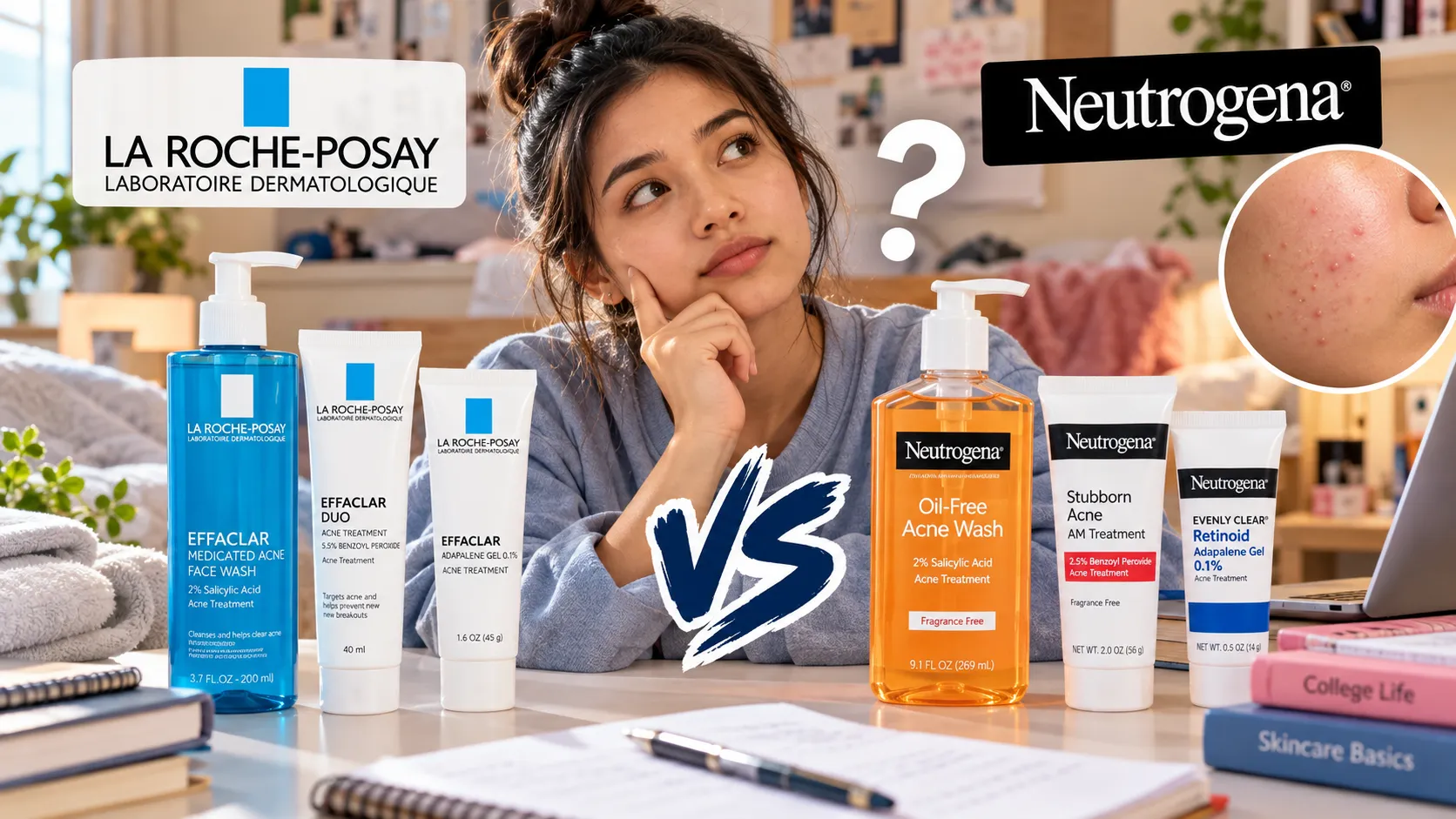
If your question is “I Am a College Student. Are La Roche-Posay Products Better for Acne-Prone Skin Than Neutrogena?”, the short answer is not automatically. Both brands sell legitimate acne products with evidence-based active ingredients, and for a college student on a limited budget, some Neutrogena products can deliver essentially the same acne-fighting active ingredient for less money.
La Roche-Posay does have well-formulated options, particularly within its Effaclar and Toleriane lines. But a higher price or dermatologist-oriented image does not make every La Roche-Posay product more effective than every Neutrogena product. For acne, the active ingredient, concentration, overall formula, skin tolerance, and consistent use matter more than the logo on the bottle.
This comparison uses current U.S. products and prices available in September 2026. Formulas, names, sizes, and availability can differ between countries.
The Most Important Difference Is the Formula, Not the Brand
The American Academy of Dermatology’s current acne guideline recommends several proven topical treatments, including benzoyl peroxide, topical retinoids such as adapalene, and salicylic acid. Benzoyl peroxide and topical retinoids receive strong recommendations, while salicylic acid is conditionally recommended.
The FDA’s U.S. over-the-counter acne monograph permits salicylic acid at 0.5% to 2% and benzoyl peroxide at 2.5% to 10% in qualifying OTC acne drugs.
That matters because La Roche-Posay and Neutrogena often use the same established acne medications.
| Acne concern | La Roche-Posay example | Neutrogena example | Practical difference |
|---|---|---|---|
| Blackheads and clogged pores | Effaclar Medicated Acne Face Wash, 2% salicylic acid | Oil-Free Acne Wash Fragrance Free, 2% salicylic acid | Same concentration of the primary acne medication |
| Inflamed pimples | Effaclar BPO Multi-Target Treatment, 5.5% benzoyl peroxide | Stubborn Acne AM Treatment, 2.5% benzoyl peroxide | Different BPO strengths and formulas |
| Persistent clogged pores and recurrent acne | Effaclar Adapalene Gel, 0.1% adapalene | Evenly Clear Retinoid Adapalene Gel, 0.1% adapalene | Same concentration of the retinoid medication |
So instead of asking which brand is stronger, it is more useful to ask which specific active ingredient matches your type of acne.
La Roche-Posay vs Neutrogena for Salicylic Acid Cleansers
For oily skin, blackheads, whiteheads, and clogged pores, the two brands are surprisingly close.
La Roche-Posay’s Effaclar Medicated Acne Face Wash contains 2% salicylic acid, plus lipo-hydroxy acid, or LHA, and glycerin. The current U.S. formula is fragrance-free and non-comedogenic, although its ingredient list also contains sodium laureth sulfate and menthol. The 200 mL, or 6.76 fl oz, bottle is listed by La Roche-Posay at $18.99.
Neutrogena’s Oil-Free Acne Wash Fragrance Free also contains 2% salicylic acid. Its current formula includes glycerin and panthenol and does not contain added fragrance.
At Target, the 9.1 fl oz Neutrogena fragrance-free cleanser was listed at about $9.99, while the 6.76 fl oz La Roche-Posay Effaclar cleanser was about $18.99 when checked. Retail prices and promotions can change.
For a student budget, that is a meaningful difference.
There is no pharmacological reason to assume that a 2% salicylic acid cleanser becomes a better acne medicine simply because it comes from the more expensive brand. The supporting ingredients and cleansing system can affect how your skin feels and tolerates the product, but both products deliver the maximum salicylic-acid concentration allowed under the FDA OTC acne monograph.
Which cleanser makes more sense for sensitive skin?
Do not assume La Roche-Posay will automatically be gentler.
The current Effaclar medicated cleanser is fragrance-free, but it contains menthol and sodium laureth sulfate. Neutrogena’s fragrance-free Oil-Free Acne Wash uses a different cleansing system and also contains hydrating ingredients such as glycerin and panthenol.
Individual tolerance matters. A product that works beautifully on oily, resilient skin can feel drying on someone whose skin barrier is already irritated from retinoids, benzoyl peroxide, cold weather, or excessive cleansing.
The AAD advises people with acne to use gentle, non-abrasive cleansers, wash no more than twice daily and after heavy sweating, and avoid excessive scrubbing and irritating products.
What About Benzoyl Peroxide for Red, Inflamed Pimples?
Benzoyl peroxide is particularly useful for inflammatory acne because it reduces acne-associated bacteria and is strongly recommended in the current AAD acne guidelines.
The current La Roche-Posay Effaclar BPO Multi-Target Acne Treatment contains 5.5% micronized benzoyl peroxide. A 40 mL size is listed at $39.99 on the company’s U.S. website.
Neutrogena’s Stubborn Acne AM Treatment contains 2.5% micronized benzoyl peroxide and is fragrance-free, oil-free, and dye-free.
A higher percentage does not automatically mean it is the smarter starting choice. The AAD specifically notes that although products containing up to 10% benzoyl peroxide exist, starting around 2.5% can help limit dryness, irritation, and burning.
That makes Neutrogena’s 2.5% option particularly reasonable for someone who is new to benzoyl peroxide or easily irritated. Someone who already tolerates benzoyl peroxide may prefer a different concentration, but more aggressive treatment is not always better treatment.
For Long-Term Acne Control, Both Brands Sell the Same Strength of Adapalene
For recurrent blackheads, whiteheads, clogged pores, and mixed acne, adapalene deserves more attention than the brand comparison itself.
Topical retinoids are among the treatments strongly recommended by the American Academy of Dermatology. They help normalize skin-cell turnover and prevent pores from becoming clogged.
La Roche-Posay sells Effaclar Adapalene Gel 0.1%, an oil-free and fragrance-free treatment intended for people aged 12 and older. It is currently listed at $39.99 for 1.6 oz.
Neutrogena also sells a 0.1% adapalene gel, including its current Evenly Clear Retinoid Adapalene Gel. Its 0.5 oz version was listed at about $14.99 at Target.
The lower Neutrogena price is easier on your wallet at checkout, although the package is much smaller. Comparing price per ounce rather than sticker price is therefore important.
Most importantly, both contain adapalene 0.1%. At the active-drug level, the La Roche-Posay product is not giving you a stronger retinoid simply because it costs more.
Also Read: Mashable Connections: Daily Hints, Answers & How It Works
Is La Roche-Posay Better for the Skin Barrier?
This is one area where some La Roche-Posay products are appealing, but Neutrogena also has competitive options.
La Roche-Posay’s Toleriane Double Repair Face Moisturizer contains glycerin, squalane, niacinamide and ceramide NP. The current U.S. formula is fragrance-free, oil-free, drying-alcohol-free and non-comedogenic. The 100 mL size is listed at $24.99.
Neutrogena’s current Hydro Boost Water Cream Fragrance Free contains glycerin, sodium hyaluronate, ceramide NP, amino acids and other moisturizing components. Neutrogena describes it as fragrance-free, non-comedogenic and suitable for sensitive or acne-prone skin.
So even here, the difference is not simply “La Roche-Posay supports the barrier and Neutrogena does not.” Modern products from both brands include barrier-supporting and hydrating ingredients.
Moisturizer is particularly useful when using salicylic acid, benzoyl peroxide or adapalene because these treatments can cause dryness and irritation. The AAD recommends looking for moisturizers labelled oil-free, non-comedogenic or won’t clog pores.
I Am a College Student. Are La Roche-Posay Products Better for Acne-Prone Skin Than Neutrogena When Budget Matters?
For most students, Neutrogena offers the easier route to a low-cost, evidence-based acne routine, particularly if you choose its fragrance-free products carefully. La Roche-Posay can still be worth buying when a particular Effaclar or Toleriane formula works noticeably better for your skin, but paying more for the entire routine is not necessary simply because you have acne.
Consider the cleanser comparison. Both brands currently offer a fragrance-free 2% salicylic acid acne wash, yet the Neutrogena option was roughly half the price of the La Roche-Posay cleanser at the retailer checked.
Adapalene shows why package size must also be considered. Neutrogena offers a cheaper small tube, while La Roche-Posay’s $39.99 adapalene comes in a larger 1.6 oz package.
A student skincare routine does not need five acne serums, several exfoliants, toner, masks and spot treatments. Buying too many active products can actually increase irritation and make it difficult to identify which product is helping or hurting your skin.
A Simple Acne Routine Makes More Sense Than Buying One Complete Brand
You do not need to use products from a single company. There is no requirement to pair a La Roche-Posay cleanser with a La Roche-Posay treatment or a Neutrogena treatment with a Neutrogena moisturizer.
A simple routine for acne-prone skin usually needs only a few functions:
Morning
- A gentle cleanser, or a salicylic-acid cleanser if your skin tolerates one.
- An appropriate acne treatment when needed.
- A non-comedogenic moisturizer.
- Broad-spectrum SPF 30 or higher.
Evening
- Gentle cleansing.
- The acne treatment you have selected, such as adapalene when appropriate and used according to its Drug Facts directions.
- Moisturizer.
The AAD recommends broad-spectrum, water-resistant SPF 30 or higher and notes that some acne treatments can increase sensitivity to sunlight. It also advises giving acne treatment time to work instead of constantly switching products.
Adding several strong products at once can make irritation more likely. Neutrogena’s own salicylic-acid Drug Facts warning notes that irritation and dryness are more likely when another topical acne medication is used simultaneously.
Which Brand Should You Choose?
Consider Neutrogena if your main priority is price. Its acne range includes 2% salicylic acid, 2.5% benzoyl peroxide and 0.1% adapalene, all established acne medications. The company now also offers fragrance-free options, so the assumption that Neutrogena acne products are necessarily harsh or heavily scented is outdated.
Consider La Roche-Posay if a specific formula suits your skin better. Its Effaclar range includes salicylic acid, benzoyl peroxide and adapalene treatments, while Toleriane provides several barrier-focused moisturizers. That can make building a sensitive-skin-oriented routine convenient.
But there is little reason for a cash-strapped student to replace a Neutrogena product that is working well simply because La Roche-Posay appears more premium.
A Practical Comparison by Acne Type
If blackheads and clogged pores are the main problem, a 2% salicylic-acid product from either brand can be reasonable.
If red inflammatory pimples dominate, benzoyl peroxide may be more relevant. Neutrogena’s 2.5% treatment offers a lower-strength starting point, while La Roche-Posay offers a stronger 5.5% option.
If you repeatedly develop blackheads, whiteheads and new breakouts, a 0.1% adapalene product may be more significant than changing cleanser brands because topical retinoids are strongly supported in acne guidelines.
If your skin is dry or irritated, focus on a gentle cleanser and non-comedogenic moisturizer rather than adding another exfoliating product.
So, Is La Roche-Posay Actually Better Than Neutrogena for Acne?
No brand-wide advantage has been established. La Roche-Posay makes several excellent acne-prone-skin products, but Neutrogena offers many of the same evidence-based medications, including 2% salicylic acid, benzoyl peroxide and 0.1% adapalene.
For a college student, the smarter strategy is usually to spend according to ingredients and skin tolerance rather than brand prestige. A $10 product containing the appropriate acne medication can be a better purchase for you than a $40 product containing an active you do not need.
If acne is painful, deep, leaving scars or persistent despite consistent over-the-counter treatment, changing from Neutrogena to La Roche-Posay is unlikely to solve the underlying problem by itself. The AAD notes that acne treatment is not one-size-fits-all and that more severe or treatment-resistant acne may require dermatologist-directed therapy.
FAQ
Is La Roche-Posay better than Neutrogena for sensitive acne-prone skin?
Not automatically. La Roche-Posay has several fragrance-free products designed with sensitive skin in mind, but Neutrogena now also offers fragrance-free acne cleansers, benzoyl-peroxide treatments and adapalene products. Compare the complete ingredient list and how your own skin responds rather than relying only on the brand name.
Can I use a La Roche-Posay cleanser with a Neutrogena acne treatment?
Yes. Skincare products do not have to come from the same brand. What matters is whether the ingredients work together without causing excessive dryness or irritation.
Is La Roche-Posay’s 5.5% benzoyl peroxide better than Neutrogena’s 2.5%?
Not necessarily. Higher benzoyl-peroxide strength can increase irritation, and the AAD recommends starting around 2.5% to help limit dryness and burning. The appropriate concentration depends on how your skin tolerates treatment.
Which brand is cheaper for a college student?
Neutrogena generally has lower upfront prices among the comparable acne products examined here. For example, a fragrance-free Neutrogena 2% salicylic-acid cleanser was about $9.99 at Target, compared with $18.99 for the smaller La Roche-Posay Effaclar medicated cleanser. Prices can change by retailer and promotion.
Does expensive skincare clear acne faster?
Price alone does not determine acne-treatment effectiveness. Evidence-based active ingredients such as benzoyl peroxide, adapalene and salicylic acid are more meaningful factors, along with concentration, tolerability and consistent use.
How long should I try an acne routine before deciding it does not work?
Acne treatment usually requires patience. The AAD advises sticking with treatment because noticeable improvement can take several weeks to a few months rather than repeatedly switching products. If acne remains persistent, becomes painful or begins causing scars, professional evaluation is appropriate.
Also Read: SoSoActive: History, Website, Content and Current Status
